
In the summer of 1943, a Danish landscape architect named Carl Theodor Sørensen walked past a construction site in the Copenhagen suburb of Emdrup and stopped to watch the children playing there. They had commandeered rubble and timber and discarded tools from an active building site, climbing the scaffolding, digging in the spoil heaps, improvising shelters from waste lumber, with a focused intensity he had never observed on the designed playgrounds he had spent his career building. “Maybe we should try,” he wrote afterward, “to give children in new residential areas a junk playground [‘skrammellegeplads’] where they can play with old cars, boxes, and other junk.” (Sorenson, 1931)
Within two years, Sørensen had opened the world’s first designated adventure playground at Emdrup, a 7,500-square-meter site stocked with loose materials, tools, and earth, staffed by a paid play leader whose role was to facilitate without directing. The idea crossed the North Sea to Britain in 1946, when landscape architect and children’s rights advocate Lady Allen of Hurtwood visited Emdrup and returned transfixed. Her 1953 pamphlet “Adventure Playgrounds” launched a British movement that by 1960 had produced dozens of sites in London’s bomb-damaged neighborhoods and public housing estates.
It took two more decades for the adventure playground movement to reach California. When it did, it found an unusually receptive environment in the intellectual climate shaped by the University of California Berkeley’s College of Environmental Design, a countercultural critique of consumer goods that resonated with Sørensen’s distrust of manufactured play equipment, and a community organizing tradition that transformed the adventure playground from a European import into something distinctly local. This article traces the journey from Copenhagen to London, from London to Berkeley, and documents the Bay Area experiments that, by 1979, had produced one of the most faithful realizations of the Sørensen model anywhere in the United States. 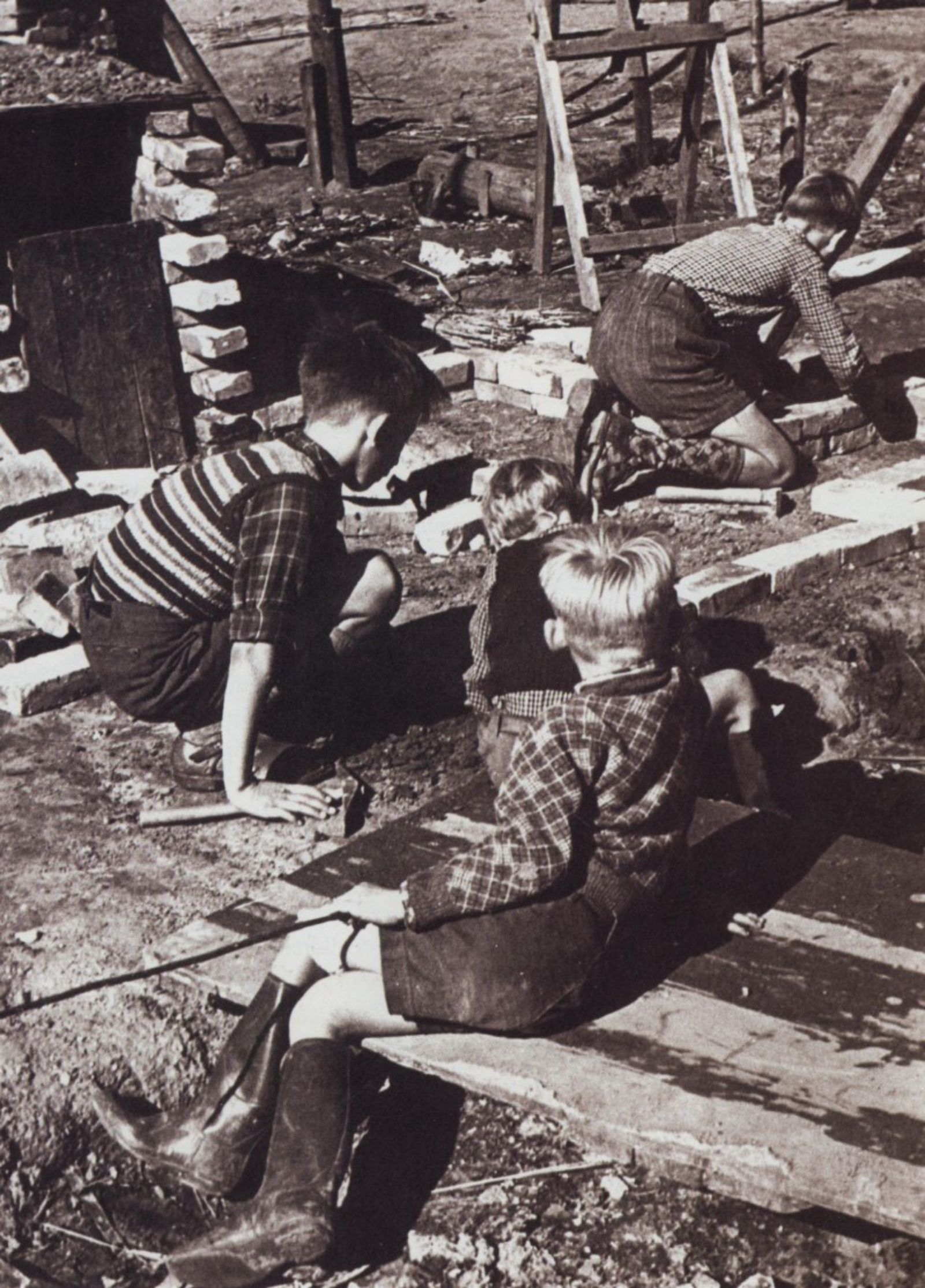
The first adventure playground designed by Carl Theodor Sørensen in Emdrup, Copenhagen, during World War II. Children building timber structures on loose-material site. Source: Lolly Tai, Letting Play Bloom, Temple University Press, 2022; original source Thames and Hudson
Loose Parts: The Adventure Playground Movement and Its San Francisco Bay Area Experiments, 1943–1979
Author
Colin Alley, AIA
Affiliation
BCV Architecture + Interiors
Tags
The Movement In Europe: From Emdrup To Lady Allen
Sørensen (1893–1979) arrived at the adventure playground through a career-long unease with his own profession. His 1931 book “Parkpolitik i Sogn og Købstad” first gave voice to his observation that children seemed genuinely happiest not on designed equipment but in the remnants of the adult world: vacant lots, building sites, and back-alleyways. For more than a decade he held this in tension with conventional practice. The 1943 construction-site epiphany in Emdrup resolved it.
The Emdrup playground opened on August 15, 1943 in the middle of the Nazi occupation of Denmark — and was an immediate success. Children came from well beyond the adjacent housing cooperative; use was intense and sustained; the range of activity exceeded anything Sørensen had seen on conventional playgrounds. Crucially, the site was staffed by a “legeværten,” a play warden whose role Sørensen regarded as inseparable from the concept. The play leader was not a supervisor but a skilled adult who could enable without controlling and facilitate without directing. This human dimension was, and remains, the element most American adaptations would struggle with.
Children’s playgrounds are the city’s most important form of public plantation and children need sun and open space to play in. He hated the trend for dark, shady courtyards as play spaces.Lolly Tai, Letting Play Bloom, summarizing Sørensen’s principles
Lady Allen of Hurtwood (1897–1976) visited Emdrup in 1946 and introduced the model to Britain, where she renamed it the “adventure playground.” Her 1953 pamphlet was followed by the 1968 book “Planning for Play”, which became the primary vehicle through which American designers and educators encountered the movement. Allen’s advocacy was explicitly directed at public housing estates and World War 2 bomb-damaged urban neighborhoods: communities with the least access to designed recreational space and the most to gain from low-cost, community-managed alternatives. The equity dimension was present in the adventure playground from its very first articulation.
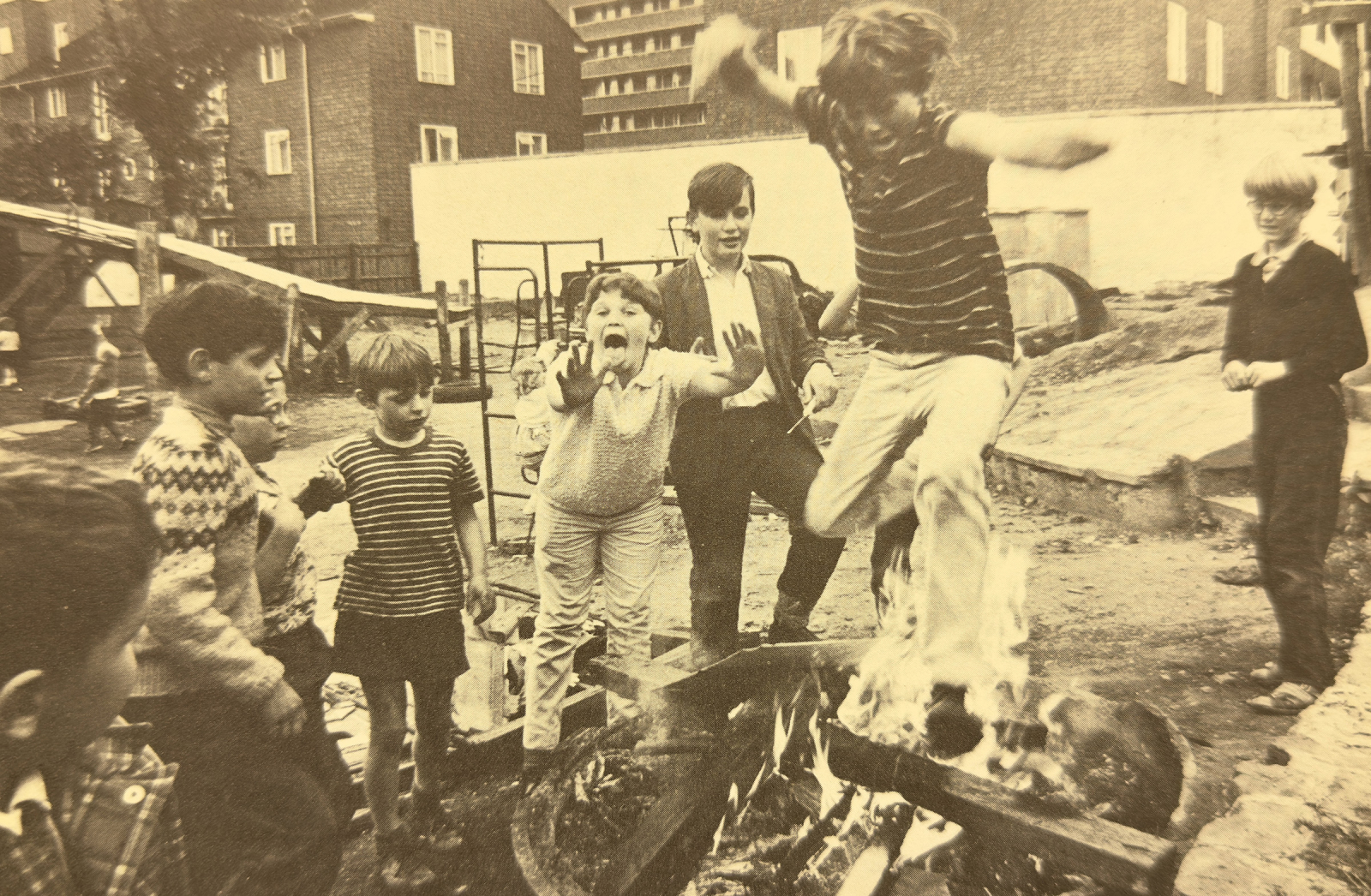
The British movement spread steadily through the 1950s and 1960s. St. John’s Wood Adventure Playground in London became one of the most photographed examples: an image of children jumping over an open fire in its muddy, material-rich landscape became something of an icon of the movement’s willingness to accept risk as educationally essential. By 1968, the London Adventure Playground Association provided coordination, training for play leaders, and advocacy with local authorities. When Allen’s “Planning for Play” arrived in American university libraries, it arrived as the distillation of twenty years of British practice.

Fig. 2 St. John’s Wood Adventure Playground, London, England. Children playing around open fire, demonstrating the British movement’s embrace of risk as integral to child development.
Credit:
Source: Lolly Tai, Letting Play Bloom, Temple University Press, 2022; original source Thames and Hudson
The American Context: Loose Parts and the Bay Area
The adventure playground idea entered American design discourse through two overlapping channels in the late 1960s and early 1970s. The first was the work of New York landscape architect M. Paul Friedberg, whose 1970 book “Playground Design” and built projects, particularly the Jacob Riis Houses playground (1966), introduced interconnected, material-rich environments to American professional practice. Friedberg’s vision was more designed and durable than Sørensen’s, but it showed that American playground culture could accommodate the principle of a varied, non-standard physical environment.
The second and more theoretically radical channel was architect Simon Nicholson’s 1971 essay “How NOT to Cheat Children: The Theory of Loose Parts,” published in “Landscape Architecture” magazine. Nicholson, at the time a faculty member at the Open University in Britain, proposed a general law that creativity in any environment is directly proportional to the number and variety of variables within it, including materials that can be moved, combined, and redesigned. The fixed, unitary playground equipment of postwar America was, by this theory, not merely uninspiring but actively suppressive of children’s creative and intellectual development. Nicholson’s essay gave the adventure playground tradition its most elegant theoretical statement, and it was widely read in Bay Area design and education circles.
The Bay Area’s receptivity to these ideas was not accidental. The University of California Berkeley’s College of Environmental Design (CED), founded in 1959, had by the mid-1960s become one of the most intellectually engaged design schools in the country, with faculty and graduate students actively connecting built environment research to social and developmental questions. Clare Cooper Marcus was conducting empirical studies of children’s outdoor environments in this period, producing some of the first American research to document systematically how children used (and did not use) standard playground equipment. The environment-behavior research program she and colleagues developed provided an academic framework that gave adventure playground principles the legitimacy that professional practice alone could not.
Equally important was the pipeline between the CED and San Francisco’s emerging community design movement. By the late 1960s, architects and planners trained at Berkeley were working with neighborhood organizations in the Mission District, Potrero Hill, and other working-class communities on projects in which playground design was a central concern. The San Francisco Community Design Center (est. 1968) served as the institutional bridge, connecting professional design resources to neighborhoods that had neither the money nor the leverage to obtain them through conventional channels.
The Yard: Washington Elementary, Berkeley, 1971–1986
The most rigorously documented Bay Area realization of adventure playground principles was not a designated adventure playground but a schoolyard: the Washington Environmental Yard, known simply as “The Yard,” at Washington Elementary School in Berkeley’s flatlands neighborhood. Initiated in the spring of 1971 by landscape architect and researcher Robin C. Moore and his co-director Herbert H. Wong, The Yard was simultaneously a design experiment, a longitudinal research project, and a community organizing effort. It is still the Bay Area’s most fully documented encounter with the adventure playground tradition.
The starting condition was unpromising: a featureless asphalt schoolyard, bounded by chain-link fences, offering nothing but game lines, metal play equipment, and sunbaked blacktop. Moore and Wong’s planning process began with a seven-month community survey, interviewing children, teachers, parents, and neighborhood residents, organizing design clinics and community feedback sessions, commissioning children’s drawings of the yard as it was and as they imagined it could be. The children’s response was unambiguous. “Boring” was the most common word. “There’s nothing to play with so there was more fighting,” wrote one student. “Kids get bored, so they mess around a lot… Kids smash glass all over, not because they’re bad but just because there’s nothing to do.” 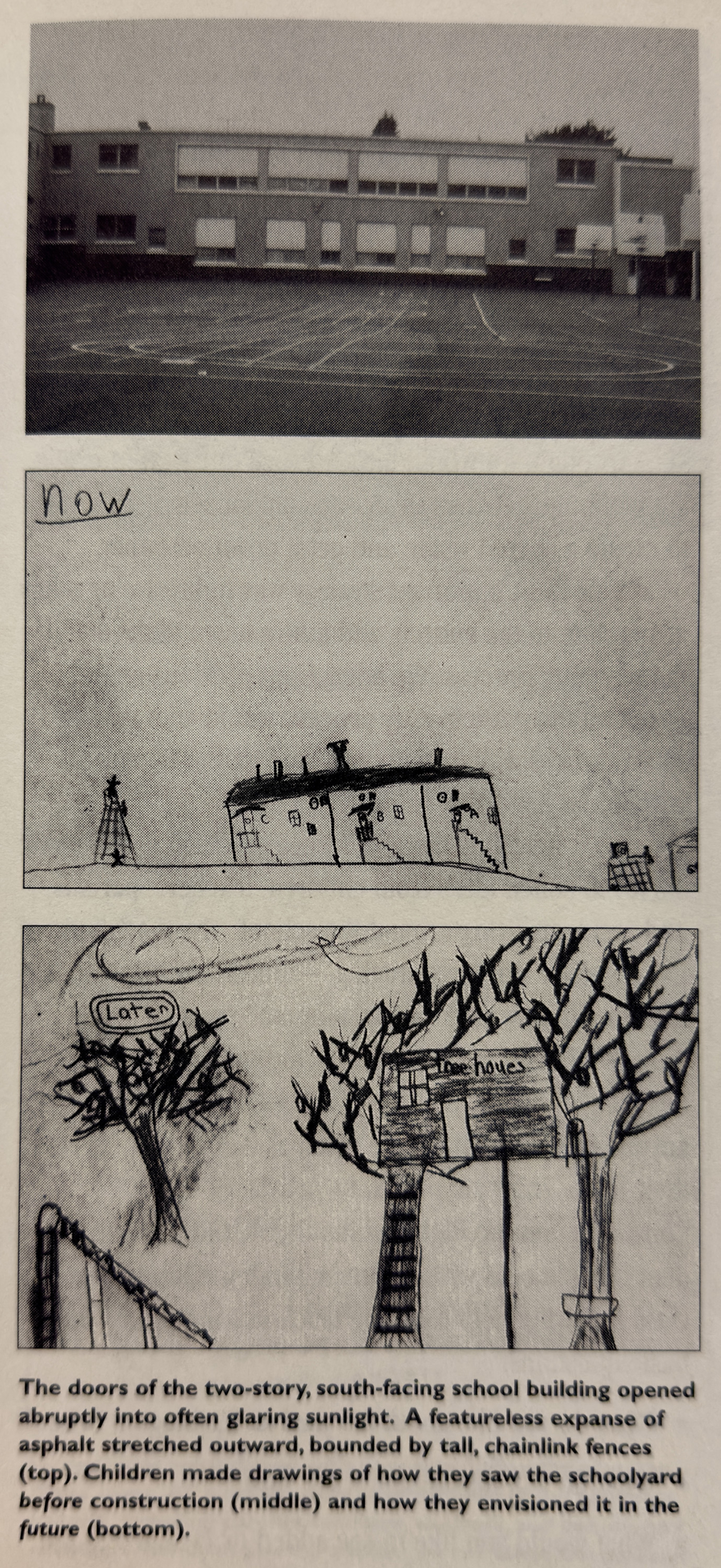
Washington Environmental Yard planning process, Berkeley, 1971–72. Children took part directly in design through surveys, drawings, and community clinics, producing proposals that shaped the final site. Source: Robin C. Moore and Herbert H. Wong, Natural Learning: The Life History of an Environmental Schoolyard, MIG Communications, 1997.
Architecture and landscape architecture students from UC Berkeley worked alongside the planning task force, analyzing survey data and proposing alternative layouts. The first physical act was symbolic and participatory: in February 1972, at a community celebration called the first “Yard Fest,” residents tore up the first squares of asphalt with their bare hands. A bulldozer borrowed from the East Bay Regional Park District then scraped off a third of the blacktop, exposing the earth beneath. Within days, the children had built dirt forts and discovered that the soil, dried and regraded into mounds and valleys, provided an instant building material analogous to the adobe bricks of California’s early settlers.
What emerged over the following fifteen years was a diverse landscape of planted areas, mounds, water features, loose-material zones, a garden, an outdoor classroom, and what Moore and Wong called “loose parts,” materials available outdoors that children could move, stack, and combine into self-directed structures and games. A UC Berkeley campus maintenance crew delivered a load of landscape prunings one afternoon and within minutes children had built camps, theaters, and forts. Logs became spaceships; boulders became distant planets; the ever-changing landscape became the curriculum.
Moore and Wong were explicit about their intellectual debts. The Yard drew directly on the adventure playground tradition, on Sørensen’s founding observation about construction-site play, on Allen’s advocacy for loose-material environments, on Nicholson’s theoretical framework. But it also extended the tradition in a distinctly American direction, integrating environmental education, formal curriculum, and behavioral research into the adventure playground model. The Yard was staffed not by a play leader in the Danish sense but by teachers and “resource persons:” floating facilitators who could work with any classroom. And, its evolution was continuously documented through behavioral observation, questionnaires, and cognitive mapping.
Funding came from multiple sources over the fifteen years: an initial grant from the Educational Facilities Laboratory in New York; California State Department of Education environmental education grants; in-kind contributions from the East Bay Regional Park District, Berkeley Parks Department, Pacific Gas and Electric, and Chevron Chemical Company. The fragility of this funding base was itself a characteristic of the adventure playground tradition: these spaces were perpetually underfunded as compared to conventional playground equipment, perpetually defended against authorities who saw them as liabilities, and perpetually sustained by the communities that used them.
The Yard’s significance for the Bay Area story is threefold. It proved that adventure playground principles could work in an American urban schoolyard context, with documented developmental outcomes. It proved the direct Berkeley CED-to-neighborhood pipeline: graduate students’ involvement in the planning and design was not incidental but structural. And it produced a body of published documentation: Moore and Wong’s “Natural Learning” (MIG Communications, 1997), the earlier Project WEY academic papers, a 1972 pamphlet, and a 16mm film, “Help Change This Yard!” (1973), that transmitted Bay Area experience back into the national and international discourse on children’s environments.

Washington Environmental Yard, Berkeley, c. 1973–78. Transformed asphalt schoolyard showing planted areas, mounds, loose materials, and children engaged in self-directed outdoor learning.
Credit:
Robin C. Moore and Herbert H. Wong, Natural Learning, MIG Communications, 1997.
The Adventure Playground: Berkeley Marina, 1979 - Present
If the Washington Environmental Yard represented the intellectual and pedagogical elaboration of the adventure playground idea, the Berkeley Adventure Playground, opened June 18, 1979, on a one-acre parcel at the Berkeley Marina, represented its most direct and most faithful Bay Area realization: a genuine “skrammellegeplads” based on the Sørensen model, staffed by play leaders and stocked with real tools and real “loose materials.”
The immediate impetus came from within the City of Berkeley’s recreation bureaucracy. In 1978, Berkeley Director of Recreation Frank Haeg attended a one-week adventure playground workshop hosted by the Adventure Playground Association. He returned persuaded, and worked with Bill Montgomery, supervisor of Berkeley city parks, to set up the playground at the marina. Montgomery was able to set aside a one-acre (.40-hectare) parcel that was, as Lolly Tai notes in “Letting Play Bloom,” “out of the way, in a public facility that allows the place to look like a junkyard and generate noise without anyone complaining.”
The site was funded through a mechanism that has sustained it for over four decades: Berkeley’s marina is a special enterprise zone, and city policy requires that revenue from marina leasing and berthing be reinvested in the marina. Scrap materials such as plywood, small wood pieces, nails, tempera paint, rope, fabric were solicited from public donations. The first coordinator, Patricia Donald, served from 1980 to 2017. Denise Brown, Berkeley’s recreation and youth services manager, then took on the position, until 2023, followed by Steph Chu, who is currently the City of Berkeley’s Manager of Recreation and Youth Services.
The site that emerged, and that has been continuously rebuilt, demolished, and rebuilt again ever since, is organized into four zones, each anchored by a permanent feature and filled with user-built structures in various states of construction and demolition: timber forts, pirate ships, a lighthouse, a cargo net, a zip line, a tire wall, fire pits, plant beds, a toolshed, and a boat. The primary materials are wood, telephone poles, rope, and tires, with minimal integration of traditional manufactured play equipment. “Everything here has been razed to the ground at one point or another,” coordinator Denise Brown told a researcher. “Each zone has its own personality, distinguished by a main play feature.”

Berkeley Adventure Playground, c. 1980s–present. Overview of playground environment. Materials include telephone poles, rope, tires, and wood.
Credit:
Colin Alley, AIA, 2026.
The play leadership model at Berkeley is as faithful to Sørensen’s original concept as any American site. Before a child can check out tools, they must find and return ten nails, five splinters, five pieces of trash, and one “dangerous nail protruding from a board,” a game-like protocol that teaches awareness of the environment and helps keep the site clean. A staff member gives orientation to groups at tables near the entrance. Tools are checked out one at a time. Staff monitor the playground in four zones, assisted by volunteers, many of whom played at the site themselves as children. “Can you scream?” a staff member asks arriving children, then answers her own question: “Yes, you can scream!”
Berkeley’s 1979 founding made it, by most accounts, the first dedicated adventure playground in the United States. It celebrated its fortieth birthday in 2019 and is still the oldest operating adventure playground in the country, one of fewer than a dozen surviving in the United States, and one of the most faithful to Sørensen’s original concept of the staffed junk playground. Approximately one thousand adventure playgrounds operate today in Denmark, Switzerland, France, Germany, the Netherlands, England, and Japan. Berkeley has been, for over four decades, the primary American proof of concept.

Berkeley Adventure Playground plan, showing its location on a one-acre (.40-hectare) site at Berkeley Marina.
Credit:
Drawing by Colin Alley, AIA, 2026.

Berkeley Adventure Playground plan detail showing four zones with their named features: cargo net, zip line platform, ramp fort, slide fort, skyscraper, lighthouse, tire wall, fire pit, and rain forest.
Credit:
Drawing by Colin Alley, AIA, 2026.
Legacy: What The Bay Area Built
The adventure playground tradition’s Bay Area arc, from the theoretical ferment of the College of Environmental Design in the mid-1960s, through Robin Moore’s Washington Environmental Yard in the early 1970s, to the opening of the Berkeley Adventure Playground in 1979, produced something that European countries had created by the dozen but that America had almost entirely failed to build: a permanent, staffed, loose-material play environment where children could build, demolish, and make genuine creative decisions about their own play.
The nature play design movement of the 2000s and 2010s, which brought natural materials, loose parts, varied topography, and water into park and school design across the Bay Area and the country, draws directly on Moore’s research and Nicholson’s theory, even when its practitioners do not know their sources. Green Schoolyards America, founded in Oakland, has worked with the San Francisco Unified School District and others to transform asphalt schoolyards using principles that Moore and Wong proved at Washington Elementary decades earlier.
The preservation question that adventure playgrounds pose is distinct from any other type of site. Their defining characteristics: impermanence, user modification, loose materials, and continuous change, are precisely the features that conventional preservation criteria struggle to recognize. There is no original fabric to protect, no architectural integrity to assess, no designed composition to document. What exists is a practice and a philosophy, embodied in specific places and specific communities of use. The Berkeley Adventure Playground, which has been razed and rebuilt continuously since 1979, cannot be preserved in any material sense. What can be preserved , through documentation, through recognition, through the kind of attention that Docomomo offers, is the argument it makes: that the most creative and developmentally productive thing a city can offer a child is a space where the environment itself is the loose part.

Emdrup Copenhagen Skrammellegeplads during World War II, Tower Construction.
Credit:
Paul Dobraszcyzyk, Adventure Playgrounds, March 13, 2020. Accessed August 28, 2026.
Sørensen watched children play in the ruins of a construction site in occupied Copenhagen and understood something that the playground equipment industry has spent eighty years trying to disprove. The Bay Area, in its way, understood it too.
Notes and Sources
- Sørensen quotation on skrammellegeplads: documented in multiple secondary sources including Lolly Tai, Letting Play Bloom (Temple University Press, 2022), pp. 51–52, and Marta Gutman, “Adventure Playgrounds and Postwar Reconstruction” in Designing Modern Childhoods (Rutgers University Press, 2008). Original Danish source: C.T. Sørensen, Parkpolitik i Sogn og Købstad (1931).
- Emdrup opening date (August 15, 1943): Tai, Letting Play Bloom, p. 52, citing Bengtsson (1972).
- Lady Allen of Hurtwood: Marjory Allen, Adventure Playgrounds (London: Housing Centre Trust, 1953); Marjory Allen and John Doidge, Planning for Play (London: Thames and Hudson, 1968).
- Simon Nicholson: “How NOT to Cheat Children: The Theory of Loose Parts,” Landscape Architecture 62, no. 1 (October 1971): 30–34.
- Washington Environmental Yard: Robin C. Moore and Herbert H. Wong, Natural Learning: The Life History of an Environmental Schoolyard (Berkeley: MIG Communications, 1997); Robin C. Moore and Herbert H. Wong, “Washington Environmental Yard (Project WEY),” unpublished paper, c. 1976–77 [in author’s collection]; Project WEY Pamphlet (Berkeley: University of California, 1972). Children’s quotations from Natural Learning, Chapter 1.
- 16mm film: Robin C. Moore and Wayne Leong, “Help Change This Yard!” (Berkeley, 1973, 6 min., b/w sound). Copies available from the Playground Clearing House, Phoenixville, Pennsylvania (per 1976–77 WEY bibliography).
- Berkeley Adventure Playground founding: Tai, Letting Play Bloom, pp. 58–59. Opening date June 18, 1979. Frank Haeg, Berkeley Director of Recreation; Bill Montgomery, Supervisor of Berkeley City Parks. Patricia Donald, first coordinator, 1980–2017.
- Play leader protocol (“Can you scream?”): Tai, Letting Play Bloom, p. 63, citing Jost (2013).
- U.S. adventure playground count: Tai, Letting Play Bloom, p. 54.
About the Author
Colin Alley, AIA, is a principal at BCV Architecture + Interiors in San Francisco, where his practice spans residential, commercial, and urban planning design. He holds a Master of Architecture from the GSAPP at Columbia University. Alongside his professional practice, he pursues independent research into Bay Area design culture and the postwar urban landscape, including the intellectual currents, imported ideas, and local adaptations that shaped how the region built for community life in the mid-twentieth century. This is his first contribution to Docomomo US.