
Throughout New England, town greens historically functioned as places where communities assembled for militia training, markets, public debate, and celebration. The Alfred E. Burr Memorial Mall, known to most Hartford residents simply as ‘Burr Mall,’ occupies a significant urban position and carries the town green tradition into the twenty-first century through modernist design.
Burr Mall: A Modern Town Green
Author
Priyanka Panjwani
Affiliation
Preservation Architect; Assistant Director, The Wadsworth
Tags
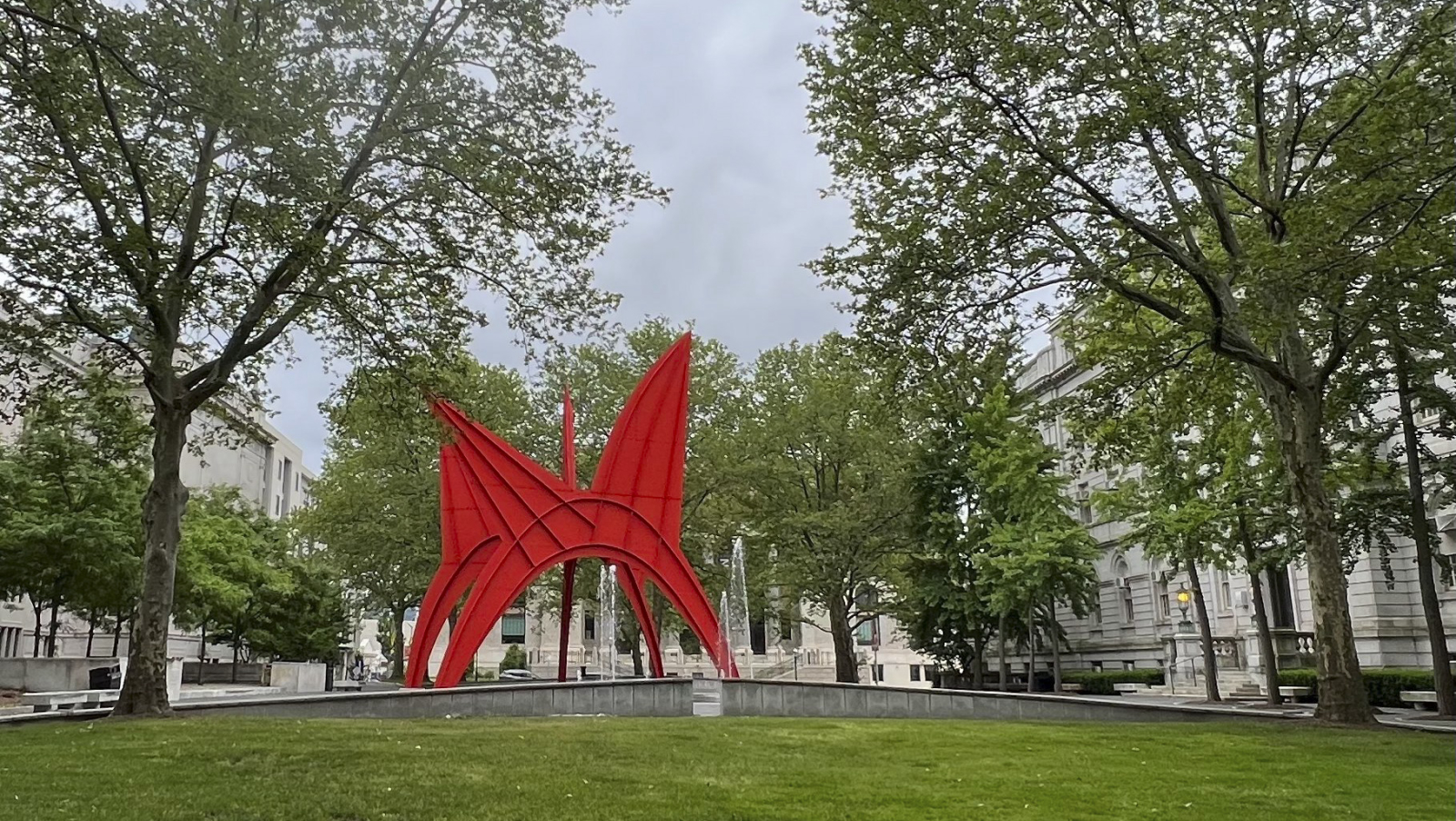

Hartford’s Modern Green: Alfred E. Burr Memorial Mall, a pedestrian public space in Downtown Hartford, Connecticut.
Credit:
Priyanka Panjwani, June 3, 2023.
The one-block, 1.14-acre modernist public plaza in downtown Hartford, Connecticut, sits between two city landmarks: The Wadsworth - the oldest continuously operating public art museum in the country - to its north, and Hartford’s Municipal Building to its south, with frontages on Main Street to the west and Prospect Street to the east. The Mall materialized between 1964, with the commission of renowned modern landscape architect Daniel Kiley, and 1973, when the iconic engineer-sculptor Alexander Calder's Stegosaurus was formally dedicated.(1)
Described as a "little wedge of the Universe," in the words of Courant Staff Writer Colin McEnroe in 1991, the Alfred E. Burr Memorial is an open, inclusive place where people gather, celebrate, encounter art, or simply spend time together, serving as both a forecourt to the Municipal Building and the city’s living room.

"A Little Wedge of the Universe." Aerial view of Burr Mall and the surrounding built environment in Downtown Hartford.
Credit:
Photograph by Einar G. Chindmark, 1973, Hartford Times Collection, Hartford History Center, Hartford Public Library, CT Digital Archive. Edited by Priyanka Panjwani; annotations added to locate the Burr Mall. Accessed July 25, 2026.
“There is no logic that can be superimposed on the city; people make it, and it is to them, not buildings, that we must fit our plans.” - Urbanist and writer Jane Jacobs
The Burr Mall emerged on the site of a former vehicular street, Atheneum Square South, inheriting a site already defined by civic participation and collective memory. A cluster of small commercial buildings - a laundry, a plumber, and a livery stable(2) - stood on the site before it was laid out as a city street in 1911, as the museum's Morgan Memorial building and the Municipal Building took shape around it.(3) The Atheneum Square South served as a dynamic gathering place. Four U.S. presidents - Truman, Eisenhower, Kennedy, and Johnson - addressed crowds from the terrace of the Hartford Times building on Prospect Street, and the Hartford Times Carol Sing gathered the city there every year from 1933 to 1972, reinforcing its role as Hartford's outdoor forum. The City officially closed the street in 1965.(4) Burr Mall exemplifies the era of urban renewal (1949–1974) at its best - prioritizing equitable pedestrian access and redirecting public infrastructure towards a shared green space.

A Public Gathering on Atheneum Square South. Aerial view of the crowd gathered outside the Hartford Times building during the holiday carol sing.
Credit:
Hartford Times, December 13, 1955. Courtesy of Hartford Times Image Collection, Hartford History Center, Hartford Public Library, CT Digital Archive.
Accessed July 25, 2026. http://hdl.handle.net/11134/50002:14899
“Long may his memory be green.”(5)
Alfred Edmund Burr (1815 - 1900) was an original thinker- honest, charming and cultured- who served as an editor, publisher and owner of the Hartford Times for several decades. Throughout his life, Burr remained a staunch supporter of Hartford and its potential for growth, and also an advocate of public improvement.(6) The Alfred E. Burr Memorial originated with a bequest from his daughter, Ella Burr McManus, who left funds in a trust in 1906 for the construction of a memorial site - a gift for the people of Hartford which was “artistic in design and humane in purpose, preferably a drinking fountain for both human beings and animals.”
What seemed a straightforward bequest evolved into one of Hartford's longest civic discussions, reflecting the city's lasting democratic culture.
The Ella Burr McManus Trust has long been managed by prominent Hartford-area community leaders, cultural ambassadors, attorneys, and business executives who serve as trustees and oversee the fund and its public art commissions. The creation of the memorial engaged influential local figures, including Hartford mayors and directors of The Wadsworth, while the allocation of the Trust's funds became the subject of prolonged public debate.
Initially, a horse trough was considered, but few horses remained in Hartford. Another enduring idea was a sculpture garden with art dispersed throughout the grounds, allowing visitors to discover art gradually while moving through the landscape.(7) From 1923 through the 1960s, the Trust’s fund expanded considerably while multiple proposals were being considered before the trustees settled on the idea of “a mall with a fountain and a sculpture.”(8)
In 1961, the Trust proposed closing Atheneum Square South.(9) To make room for the Mall, the City and The Wadsworth each made land available from their adjoining properties - a rare instance of private-to-public generosity. The agreement with the Trust also gave the museum final approval over all sculpture and aesthetic aspects of the Mall.
The vision for the mall was “An urban park for the 20th century, a park that was to provide shade, serenity, the sound of water to deaden the adjoining urban automobile noises, and to be a special interaction of art and landscape.”(10)
Considered “a DiMaggio of mulch and marble,” Daniel Urban Kiley (1912 - 2004), America’s foremost landscape architect, was selected to design the Burr Memorial in 1964. Over his career, Kiley worked on significant landscapes from Lincoln Center in New York to the Jefferson Memorial Arch in St. Louis. He collaborated with some of the era’s most influential architects- Eero Saarinen, Louis Kahn, I. M. Pei among them. He brought to Burr Mall the same disciplined geometry and refined spatial order that defined his career.
“The distinguishing feature of a Kiley landscape was the use of a limited palette of plant types and inert materials in bold geometric patterns to achieve a coherent restful landscape. The simplicity of such an approach created a kind of materialized poetry in a quiet precinct of a noisy turbulent city.” – Landscape architect Henry Arnold, 2013.(11)
The urban oasis that Kiley planned for the Alfred E. Burr Memorial is symmetrical across both its east-west and north-south axes. Broad lawns lined with sycamore trees flank Main Street and Prospect Street. Corner diagonal allées guide pedestrians inward to Kiley's original recessed fountain, encircled by bollards at the center.(12) The initial design envisioned a large sculpture rising from the lower basin and extending approximately six feet above ground. The intimately scaled concourse, built between 1967- 69, features elegant stone benches and simple lighting; a row of ginkgo trees lines the south edge of the plaza, adjacent to the Municipal Building. The tree canopy and fountain softened the urban environment, inviting people to gather for breaks, children to watch the water dance, and creating a setting for movement, sound, discovery, and play. The Mall was dedicated on October 10, 1969.

Before the Stegosaurus - Dan Kiley’s Burr Mall Landscape. This historic view captures the geometry of Dan Kiley’s landscape design prior to the dedication of Alexander Calder’s Stegosaurus sculpture in 1973.
Credit:
Courtesy of Hartford Times, Hartford Times Collection, Hartford History Center, Hartford Public Library, CT Digital Archive. Accessed July 25, 2026. https://hdl.handle.net/11134/4027377
Following the dedication, the Trust sought guidance for the sculpture from former Burr Memorial Trustee and The Wadsworth director Charles C. Cunningham, who recommended Andrew Ritchie, retired director of the Yale University Art Gallery and an expert in modern art. Seeking to fulfill the will’s directive to employ “the most competent and gifted sculptor known,” the Trust turned to Ritchie. Museum director James Elliott oversaw the selection process, which considered artists including Picasso, Tony Smith, and Henry Moore. After a five-year search, the Trust chose Alexander Calder in 1972 to create the sculpture for Burr Mall, with The Wadsworth playing an instrumental role in bringing his work to Hartford.
A long-time Connecticut resident, Calder (1898 - 1976) was one of America's most innovative twentieth-century artists, who revolutionized abstract sculpture by creating moving artworks (mobiles) and large-scale stationary pieces (stabiles) characterized by bold, organic forms and bright colors. He was inspired by the works of Dutch painter Piet Mondrian and enthralled with the idea of setting a Mondrian in motion, using materials and techniques of the machine age. Calder’s selection was a statement: Hartford was willing to place contemporary art at the very center of its civic life.
“Calder makes us see the world with the innocence of childhood- a world that exists but whose beauties in this age of violence and materialism are blurred and overshadowed.”(13)
If Daniel Kiley gave Burr Mall its civic framework, Alexander Calder gave it its unmistakable identity - a custom stabile sculpture named Stegosaurus, designed for the plaza. Sited beside the fountain and visible from all four corners, Stegosaurus stands nearly fifty feet tall and weighs forty tons.(14)
Originally intended to straddle the fountain, the sculpture was shifted back to shorten the span of the front legs- now thirty-seven feet, which also reduced its overall height. Stegosaurus is composed of forty-five curved and ribbed steel plates that are bolted together to resemble a semi-abstract dinosaur from the Jurassic period, which once roamed the Wyoming and Colorado regions. Pointed forms from the sculpture thrust skyward “like a church steeple,” and it is painted in Calder's signature matte orange-red color.(15)
Alexander Calder emphasized that his work had no fixed meaning, but simply aimed “to create something interesting to look at.”(16)
The sculpture continues to charm people of all ages with its art, wit, and poetic imagery. It is experiential and is meant to be walked around, under, and past. People wander around it and use it as a meeting spot, each finding their own ways to interpret and interact with this piece. The sculpture also anchors the Memorial- an urban buffer, a daily gathering place, and a venue for festivals, performances, and educational programming. Dedicated in October 1973 with a Stegosaurus Festival, the sculpture immediately transformed Burr Mall into one of Connecticut's most recognizable public spaces and has captivated passersby ever since.

"Movement and Memory in the Public Plaza." A performance by members of the Hartford Ballet Company beneath Alexander Calder’s Stegosaurus sculpture, demonstrating Burr Mall’s role as a setting for art, interaction, and shared memory.
Credit:
Hartford Times, 1968–1976, Hartford Times Collection, Hartford History Center, Hartford Public Library, CT Digital Archive.
Accessed July 25, 2026. https://hdl.handle.net/11134/4027467
“To dismember Burr Mall would be a sacrilege. Think of King Kong in the movies; Calder had a colossal sense of humor. If anything, you should stand up and salute everytime you go by” - Professor Alden Gordon, chairman of Department of Arts at Trinity college.(17)
Burr Mall has continued to evolve. By the 1980s and '90s, as the landscape matured - with overgrown trees, an aging fountain, and changing maintenance needs - public debate arose over whether, and how, to renovate this modernist public landscape.(18) Preservationists, landscape architects, museum professionals, and local residents all weighed in- the same debate familiar to anyone who has fought to keep a modernist landscape from being written off simply for being old.
“Gardens, too, are often created, and subsequently experienced, as commentary and response: a focus of speculations, propositions, and negotiations concerning what it is to live in the world.” - Landscape historian and author John Dixon Hunt
In 1988, the Trust engaged CR3 Inc., a local landscape architecture firm in nearby Simsbury, to plan the renovation. The Mall’s original scheme was partially modified by introducing low, curving granite walls to echo the geometry of the sculpture and a marble oval surrounding a dry floor fountain with flush nozzles. The new design retained the Mall’s central relationship between art and landscape while introducing new plantings. The 1993 alterations, shaped by community input and local professionals, were marked with a rededication ceremony. Subsequent updates were similarly celebrated by the Trust in 2008 and 2019.

The evolving landscape of the Burr Mall: a contemporary view documenting the transformation of the original landscape design through subsequent interventions, including the redesigned fountain and site alterations completed by CR3 Inc. of Simsbury in the early 1990s.
Credit:
Priyanka Panjwani, August 10, 2022.
Just as Mr. Burr's conversations once brought people "a needed calmness of mind and revival of hope," Burr Mall offers that same solace to those who encounter it today.(19) As a site of commemoration, civic gathering, and quiet contemplation in the heart of Downtown Hartford, Burr Mall merits broader recognition within the history of American modernist landscape design.

Reading the Civic Landscape: a Jane's Walk-through Burr Mall, Hartford. Participants gather during a Jane’s Walk event celebrating activist Jane Jacobs’s birthday, discussing the urban design principles, landscape composition, and civic role of the site. Led by Cecil Adams, Director of Facilities, and Priyanka Panjwani, Assistant Director of Facilities, at The Wadsworth.
Credit:
Dhiraj Panjwani, May 2, 2026.
Notes
1 Preservation Connecticut, “Alfred E. Burr Mall and ‘Stegosaurus.’, April 28, 2016.
2 Sterner, “What Used to Be Where the Wadsworth Atheneum & Municipal Building Stand Today in Hartford, CT?”
3 Close, History of Hartford Streets, 42. The Street name was adopted on Aug 15, 1921.
4 Karen Sullivan. “Free the Steg,” The Hartford Courant, March 19, 1989
5 “He Made History,” editorial notice from The New Britain Herald, in A Memorial: Alfred E. Burr, March 27, 1815–January 8, 1900, Founder of the Hartford Daily Times (Hartford, 1900), 87
6 “Stegosaurus Festival Celebration Issue,” The Hartford Times, October 9, 1973.
7 Berkman, Florence. “Calder Was ‘Disappointed’ with Burr Mall.” The Hartford Courant, April 2, 1989, 2.
8 Karen Sullivan. “Free the Steg,” The Hartford Courant, March 19, 1989
9 Alfred E. Burr Memorial Mall Rededication Luncheon, program, October 1, 1993
10 Holland, Peter. “City Landscape Design Is Worth Restoring.” The Hartford Courant, April 6, 1991, 1.
11 The Cultural Landscape Foundation. The Landscape Architecture Legacy of Dan Kiley, 16.
12 “Sculpture Mall Closes Atheneum Square South,” The Hartford Courant, June 4, 1968, 37.
13 Berkman, “Stegosaurus Festival Celebration Issue,” Hartford Times, October 9, 1973.
14 Berkman, “40-Ton Calder Sculpture for Mall,” 1972.
15 Connecticut Trust for Historic Preservation (now Preservation Connecticut), “Alfred E. Burr Mall and ‘Stegosaurus,’” Creative Places: Arts & Letters Project, Historic Resource Inventory, April 28, 2016.
16 Berkman, “Stegosaurus Festival Celebration Issue,” Hartford Times, October 9, 1973.
17 Sullivan, “Free the Steg,” 17.
18 Berkman, Florence. “Calder Was ‘Disappointed’ with Burr Mall.” The Hartford Courant, April 2, 1989, 2.
19 A Memorial: Alfred E. Burr, March 27, 1815–January 8, 1900, Founder of the Hartford Daily Times. Hartford, 1900.
Bibliography
A Memorial: Alfred E. Burr, March 27, 1815–January 8, 1900, Founder of the Hartford Daily Times. Hartford, 1900. Copy made available by the Ella Burr McManus Trust, caretaker of the Alfred E. Burr Memorial (Burr Mall).
“Abstract Sculpture to Adorn Burr Mall.” The Hartford Courant, June 1, 1972, 31. Accessed July 7, 2026. https://proxy.westhartfordlibrary.org/login?url=https://www.proquest.com/newspapers/abstract-sculpture-adorn-burr-mall/docview/551207349/se-2.
Alfred E. Burr Memorial Mall Rededication Luncheon. Luncheon program. October 1, 1993. Hartford Public Library Reference Department. Consulted at the Hartford History Center, Hartford Public Library, July 14, 2026.
“Art Mall Dedication Scheduled.” The Hartford Courant, November 21, 1969, 37. Accessed July 25,2026. https://proxy.westhartfordlibrary.org/login?url=https://www.proquest.com/newspapers/art-mall-dedication-scheduled/docview/550305399/se-2.
Berkman, Florence. “40-Ton Calder Sculpture for Mall.” Hartford Times, May 31, 1972. Hartford Public Library Reference Department. Consulted at the Hartford History Center, Hartford Public Library, July 14, 2026.
Berkman, Florence. “Don’t Tamper with Stegosaurus’ Stomping Grounds.” Hartford Times, October 10, 1991. Hartford Public Library Reference Department. Consulted at the Hartford History Center, Hartford Public Library, July 14, 2026.
Berkman, Florence. “Calder Was ‘Disappointed’ with Burr Mall.” The Hartford Courant, April 2, 1989, 2. Accessed July 25, 2026. https://proxy.westhartfordlibrary.org/login?url=https://www.proquest.com/newspapers/calder-was-disappointed-with-burr-mall/docview/1638290870/se-2.
“Burr Mall Redux.” The Hartford Courant, April 20, 2008. Accessed July 25, 2026. https://www.courant.com/2008/04/20/burr-mall-redux/.
Calder Foundation. “Stegosaurus (1972).” Accessed July 25, 2026. https://calder.org/works/monumental-sculpture/stegosaurus-1972/.
“Calder Dinosaur Sculpture to Be Installed Today.” The Hartford Courant, April 30, 1973, 30. Accessed July 25, 2026. https://proxy.westhartfordlibrary.org/login?url=https://www.proquest.com/newspapers/calder-dinosaur-sculpture-be-installed-today/docview/551522814/se-2.
Close, F. Perry. History of Hartford Streets. Hartford: The Connecticut Historical Society, 1969. Consulted at the Hartford History Center, Hartford Public Library, July 14, 2026.
"Correction," June 27, 1984, Loose archival page correcting factual errors in the June issue of Wadsworth Atheneum News concerning the Alfred E. Burr Memorial. Hartford Public Library Reference Department. Consulted at the Hartford History Center, Hartford Public Library, July 14, 2026.
“Council Urged to Approve Mall between City Hall, Atheneum.” The Hartford Courant, March 29, 1966, 15. Accessed July 25, 2026. https://proxy.westhartfordlibrary.org/login?url=https://www.proquest.com/newspapers/council-urged-approve-mall-between-city-hall/docview/549057894/se-2.
Fakharany, Nour. “Exploring the Legacy of Modernist Landscape Architect Dan Kiley.” ArchDaily, January 10, 2024. Accessed July 25, 2026. https://www.archdaily.com/1012046/exploring-the-legacy-of-modernist-landscape-architect-dan-kiley
Ferreira, Diogo Borges. “Exploring the Legacy of Modernism in Landscape Architecture.” ArchDaily, September 25, 2024. Accessed July 25, 2026. https://www.archdaily.com/1021225/exploring-the-legacy-of-modernism-in-landscape-architecture.
Harris, Laurie Lanzen, and Cherie D. Abbey, eds. Biography Today: Profiles of People of Interest to Young Readers. Artists Series. Vol. 1. Detroit: Omnigraphics, 1996. Accessed July 25, 2026. https://files.eric.ed.gov/fulltext/ED422217.pdf.
Holland, Peter. “City Landscape Design Is Worth Restoring.” The Hartford Courant, April 6, 1991, 1. Accessed July 25, 2026. https://proxy.westhartfordlibrary.org/login?url=https://www.proquest.com/newspapers/city-landscape-design-is-worth-restoring/docview/1851273539/se-2.
Hunt, John Dixon, ed. A Cultural History of Gardens in the Modern Age. London: Bloomsbury Academic, 2016.
Lodge, Robert G., and Emmett W. Lodge. Notes for a History of “Calder Red” Color and Its Paints in the United States in Relation to the Recoatings of Alexander Calder’s Flamingo (1973) and La Grande Vitesse (1969) and Other Calder Stabiles. McKay Lodge Conservation Laboratory, n.d. Accessed July 25, 2026. https://mckaylodge.com/wp-content/uploads/2015/01/CALDER-RED-PDF.pdf.
McEnroe, Colin. “The Mall Brawl: Plaza’s Redesign Opens Fountain of Debate.” The Hartford Courant, July 31, 1991, 2. Accessed July 25, 2026. https://proxy.westhartfordlibrary.org/login?url=https://www.proquest.com/newspapers/mall-brawl/docview/1839661919/se-2.
Preservation Connecticut. “Alfred E. Burr Mall and ‘Stegosaurus.’” Creative Places: Arts & Letters in 20th Century Connecticut. Historic Resource Inventory, CT Trust Resource ID 4158. April 28, 2016. Accessed July 25, 2026. https://connecticutcreativeplaces.org/places/burr-alfred-e.-mall-and-stegosaurus1.
Preservation Connecticut. Town Greens. Accessed July 10, 2026. https://towngreens.com/.
Rudd, Edward M. “Fountain Sculpture Is Delayed.” The Hartford Courant, August 6, 1970, 25. Accessed July 8, 2026. https://proxy.westhartfordlibrary.org/login?url=https://www.proquest.com/newspapers/fountain-sculpture-is-delayed/docview/550562127/se-2.
“Sculpture Mall Closes Atheneum Square South.” The Hartford Courant, June 4, 1968, 37. Accessed May 1, 2026. https://proxy.westhartfordlibrary.org/login?url=https://www.proquest.com/newspapers/sculpture-mall-closes-atheneum-square-south/docview/549834685/se-2.
Sterner, Dan. “What Used to Be Where the Wadsworth Atheneum & Municipal Building Stand Today in Hartford, CT?” YouTube video, 28:06. January 28, 2022. Accessed July 25, 2026. https://www.youtube.com/watch?v=dpR37JVokqM.
Sullivan, Karen. “Free the Steg: In Pursuit of Hidden Meanings and the Redemption of a Dinosaur.” The Hartford Courant, March 19, 1989, 17. Accessed July 25, 2026. https://proxy.westhartfordlibrary.org/login?url=https://www.proquest.com/newspapers/free-steg/docview/1644944221/se-2.
Swift, Mike. “Judge Approves Use of Fund to Renovate Mall.” The Hartford Courant, January 31, 1991, 1. Accessed July 25, 2026. https://proxy.westhartfordlibrary.org/login?url=https://www.proquest.com/newspapers/judge-approves-use-fund-renovate-mall/docview/1835989271/se-2.
The Cultural Landscape Foundation. The Landscape Architecture Legacy of Dan Kiley. Accessed July 25, 2026. https://www.tclf.org/sites/default/files/microsites/kiley-legacy/.
Acknowledgement: The author gratefully acknowledges the help and encouragement of librarians and staff at the Hartford History Center, the Connecticut State Library, and the Auerbach Art Library and Museum Archives at The Wadsworth.
Acknowledgement of AI Assistance: This article was developed with assistance from OpenAI’s ChatGPT and Anthropic’s Claude for editing, proofreading, and improving clarity of written expression. All research, interpretation, and conclusions are the author’s own.
Author
Priyanka Panjwani is a preservation architect from India, based in West Hartford, Connecticut. She is an Assistant Director of Facilities at The Wadsworth and has long been an active volunteer at the museum. With over ten years of experience in heritage and architecture across India and the United States, Priyanka also serves on the Connecticut State Historic Preservation Review Board and the Board of Trustees of Preservation Connecticut. Priyanka has lectured on place, architecture, preservation, and climate change, and in May 2026, she co-hosted a Preservation Connecticut Jane's Walk titled Burr Mall: Revolution to Recreation.