Rothko Chapel

National Register of Historic Places, 2000
John and Dominique de Menil first conceived of the Rothko Chapel in 1964 as a Catholic chapel affiliated with the University of St. Thomas. However, the plan for the Chapel gradually grew away from the more traditional worship space envisioned by the University, and in 1969, the de Menils decided instead to donate the Chapel to the Institute of Religion and Human Development, which provided chaplaincy training in the Texas Medical Center. By 1972, the Chapel’s mission had diverged from that of the Institute, as well, and the chapel became an independent entity. The Chapel’s official mission is to “provide a place of worship, meditation and prayer for persons of all faiths; to provide a forum for people to gather and explore spiritual bonds common to all; to discuss human problems of worldwide interest; and to share a spiritual experience, each loyal to his or her belief, each respectful of the beliefs of others.”
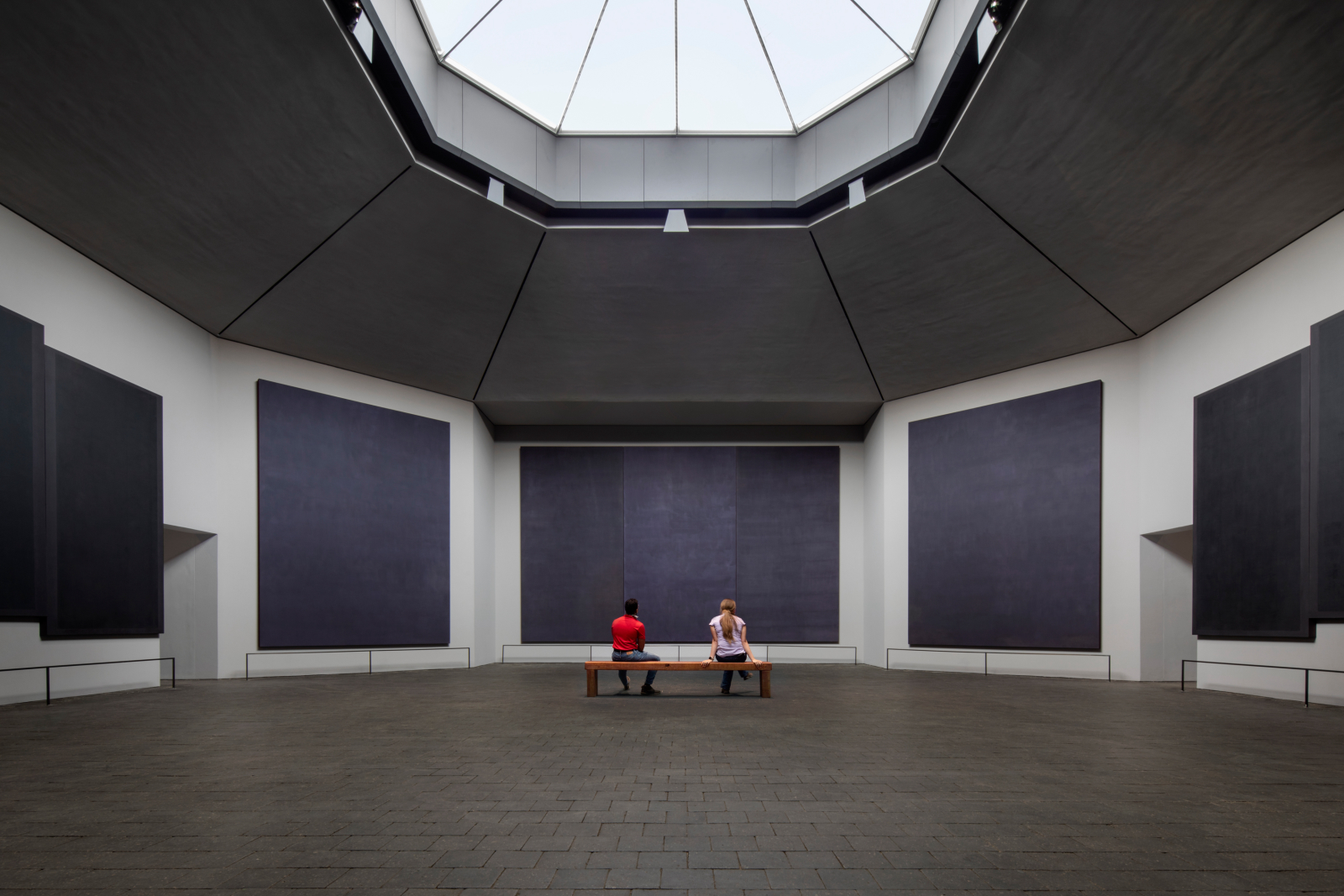
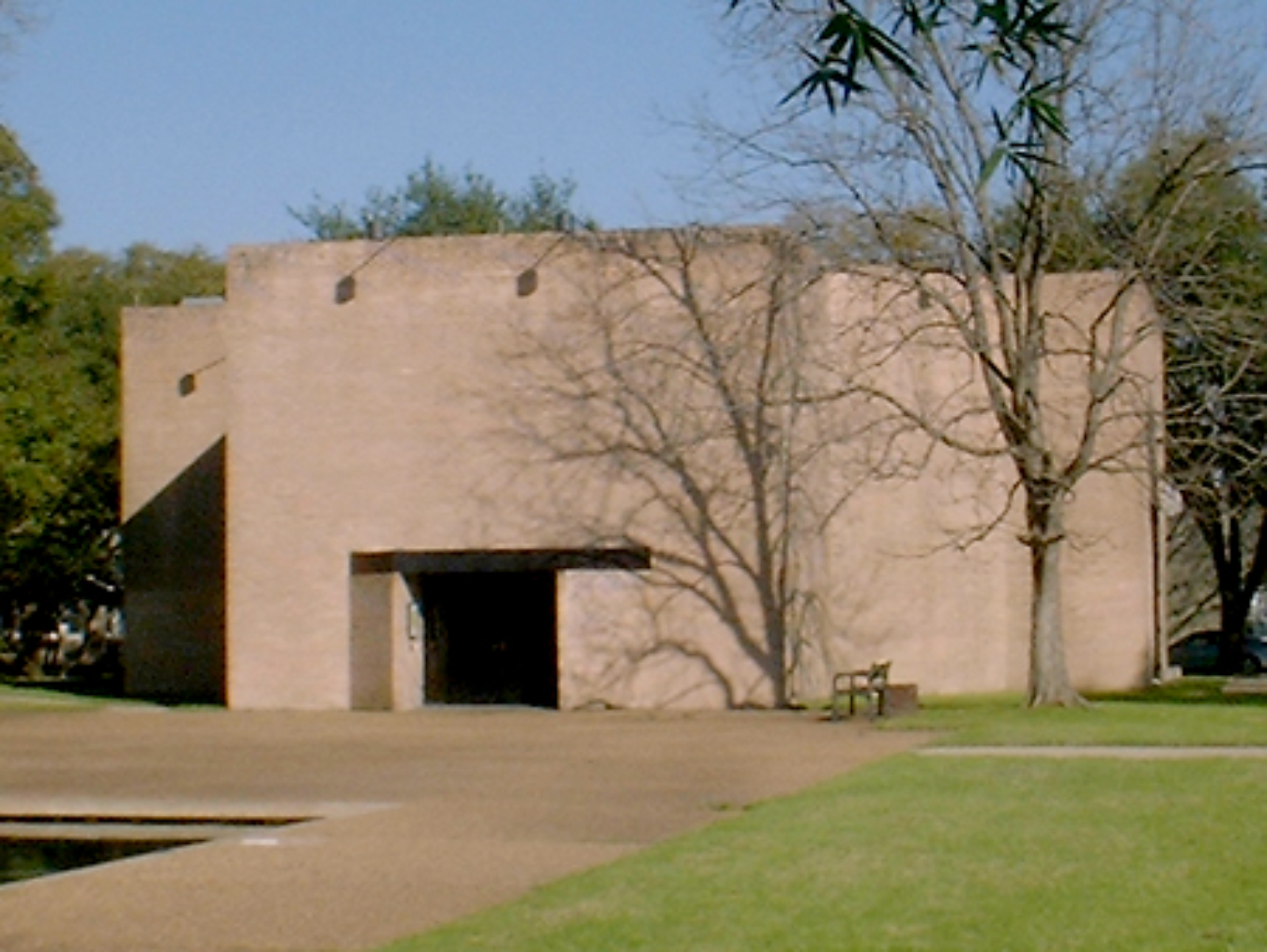
In keeping with Rothko’s wishes, the Chapel is a simple brick-exterior, flat-roofed, one-story building, entirely different from Johnson’s original idea for a white stucco, concrete block building monumentally topped by a pyramid. Live oak trees surround the Chapel, located next to a reflecting pool and the Cor-Ten steel sculpture Broken Obelisk. The building is irregularly octagonal in plan, with four wider principal walls alternating with four secondary walls, and with a rectangular apse and recessed floor. Rothko carefully configured his seven black canvases and seven plum-colored canvases; there is a triptych of paintings on each of the north, east, and west walls, one painting on the south wall, and one painting on each of the diagonal walls.
Paintings: Fall 1964 – April 1967. Building: May – October 1970. Painting installation: February 1971.
The Rothko Chapel is situated one block west of the University of St. Thomas campus, with which it was originally affiliated. During the course of several years prior to 1972, the de Menils had acquired a number of entire blocks in this neighborhood of largely 1920s bungalows, with the intention of building storage and study centers for their art collection (which would eventually be housed in the 1987 Menil Collection building one block west of the Chapel). The Neartown area of Houston, where the Chapel is located, was known as a center of Bohemian culture in the 1960s and 1970s.
Rothko objected to the sterility of white walls and experimented with shades of gray before finally insisting that the Chapel’s materials should remain unpainted and in their natural states. The interior walls would consist of concrete blocks with uncolored plaster sprayed on the surface. At a meeting with Aubry two weeks before his own death, Rothko approved samples of the brick for the exterior façade and the asphalt blocks for the floor.
Although originally conceived as a Catholic chapel, the Rothko Chapel soon became an independent, interfaith place for spiritual contemplation. It has been called the world’s first broadly ecumenical center. The Chapel has come to signify the ecumenical power of art and has fostered discussions about social justice and human rights, bringing together such figures from around the world as the Dalai Lama, Nelson Mandela, and Jimmy Carter. The Chapel also gives out periodic awards in recognition of human rights efforts. In keeping with the Chapel’s spirit of peace and equality, the statue Broken Obelisk, installed in front of the Chapel in 1971, was dedicated to the memory of Martin Luther King, Jr.
Rothko’s extensive input in the Chapel’s architectural design resulted in marked interplay between his paintings and the building’s plan. Unlike with his two previously commissioned series—the 1958 murals originally intended for the Four Seasons Restaurant in New York City’s Seagram building, and the 1962 murals for the Holyoke Center at Harvard—Rothko was not painting for a predesigned space but was able to help shape the setting for his work. He did not begin the paintings until the plan and interior walls were decided. The Chapel is significant not only as a work of modernist architecture but also, because of Rothko’s paintings, as a work of modern art. As such, the Chapel blurs the line between architecture and art, challenging this distinction in both its aesthetic effect and the struggle involved in Johnson and Rothko’s attempted collaboration in its design.
The Chapel was named to the National Register of Historic Places in 2001, 30 years after its construction, an exception to the normal 50 year limit. According to Suna Umari, the Chapel’s executive director at the time, "The committee that approved the chapel's designation felt that because in the last 25 years there was enough documentation and recognition of it there was no question about its significance. Additionally, the fact that the artist, Mark Rothko, passed away some years ago means there will never be another one created.” Rothko’s suicide a year before the Chapel’s opening influenced some critics and visitors to view the darkly-colored paintings inside as bleak and disheartening, but the artworks are otherwise appreciated as expressing a sense of solitude and spirituality that transcends their color. Considered Rothko’s greatest work, the Chapel is internationally reputed, though not so much for the architecture itself as for the art that dictates it. The Chapel has been compared in importance to the Chapel of the Rosary in Vence, France, by Henri Matisse and the Chapel in Ronchamp, France, by Le Corbusier.
The Rothko Chapel is a monument to the legacy of Mark Rothko, as well as that of the de Menils, who played a key role in developing Houston’s cultural life. The Chapel has long been a popular tourist site in the city, where it is often viewed in conjunction with the nearby Menil Collection; in fact, attendance at the Chapel doubled from 20,000 to 40,000 people per year after the museum opened in 1987. Internationally celebrated, the Chapel has also inspired other renowned works, such as the 1971 classical music piece “Rothko Chapel” by composer Morton Feldman, which continues to be performed (for instance, by the San Francisco Symphony in February 2011).
“Art and Architecture.” Rothko Chapel. 28 Jan. 2011 .
Barnes, Susan J. The Rothko Chapel: An Act of Faith. Austin: University of Texas Press, 1989.
Dewan, Shaila K. “Restoring Rothko's Chapel and His Vision.” New York Times. 15 June 2000. 28 Jan. 2011 .
Evans, Marjorie. “30 year-old building goes down in history: Rothko Chapel now in national registry.” Houston Chronicle. 24 Jan. 2001. 28 Jan. 2011 .
Holmes, Ann. “Making of the Rothko Chapel: New book gives inside account of how ‘A Stonehenge for us’ came to be.” Houston Chronicle. 7 May 1989. 28 Jan. 2011 .
Johnson, Patricia C. “Meditation on a chapel: Structural problems resolved, Rothko Chapel stands ready to reclaim its place as sanctuary of art and spirituality.” Houston Chronicle. 11 June 2000. 28 Jan. 2011 .
“Mission Statement.” Rothko Chapel. 28 Jan. 2011 .
“Museum Building.” The Menil Collection. .
"San Francisco Symphony: MTT to lead ‘Rothko Chapel’ and Mozart’s Requiem." Stark Insider. 28 Jan. 2011. 31 Jan. 2011 .
“The Global Stage.” Rothko Chapel. 28 Jan. 2011 .
“The Rothko Chapel.” The Menil Collection.
Van Ryzin, Jeanne Claire. “Chapel renovation brings Rothko secrets to light.” Austin American Statesman. 18 Aug. 2000. 28 Jan. 2011 .
"Welcome to OurBlok, Neartown!" OurBlok.com. 31 Jan. 2011 .