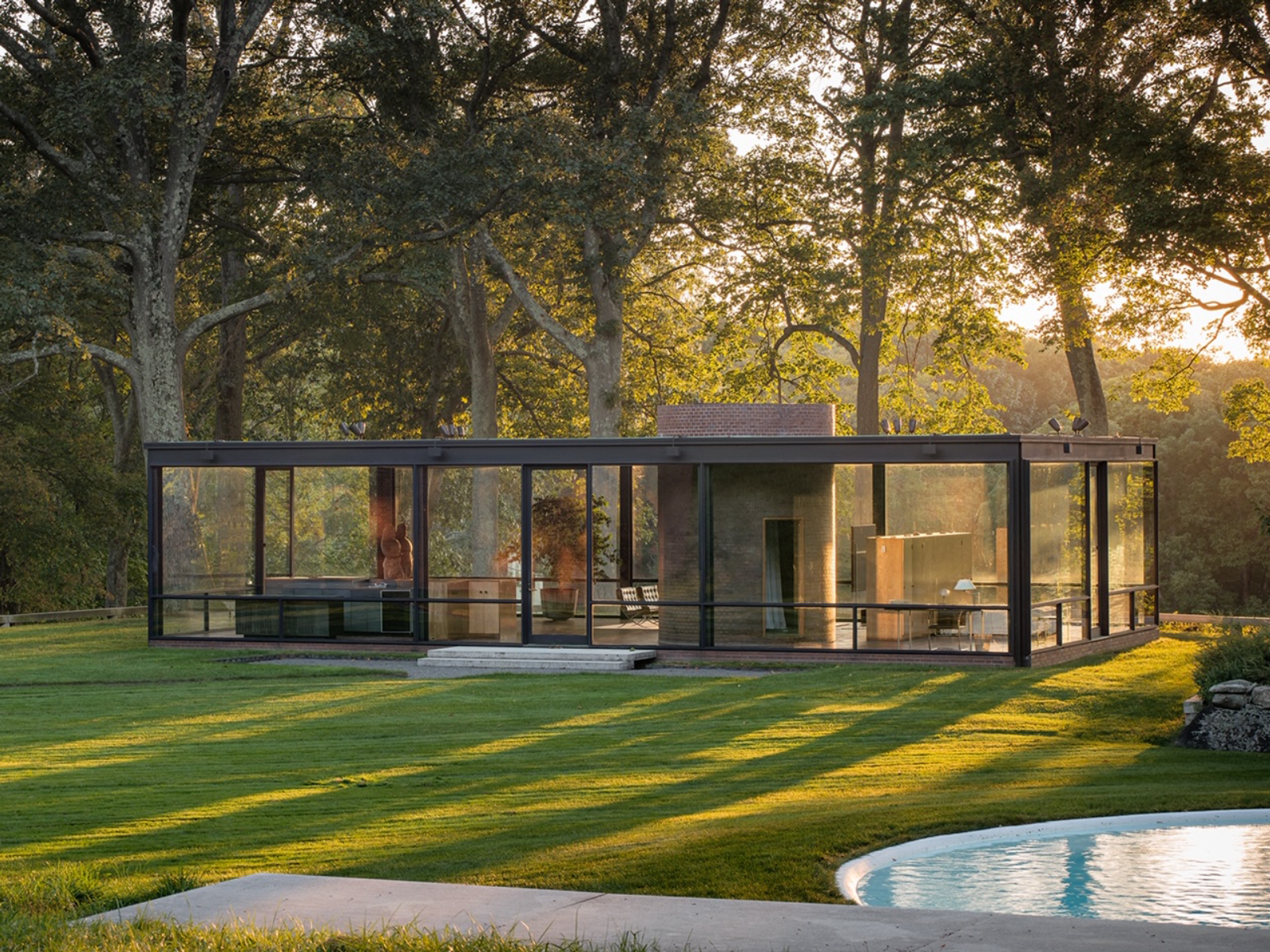
Name of surrounding area: New Canaan, Ct.
Type of area: Open fields, stone walls, and scattered clusters of trees; from the road along the ridge, the land gently slopes downward westerly toward a bluff, where it then descends steeply to a small pond and wooded area on the western ridge of the property.
Visual relation: Site provides full sunrise/sunset exposure
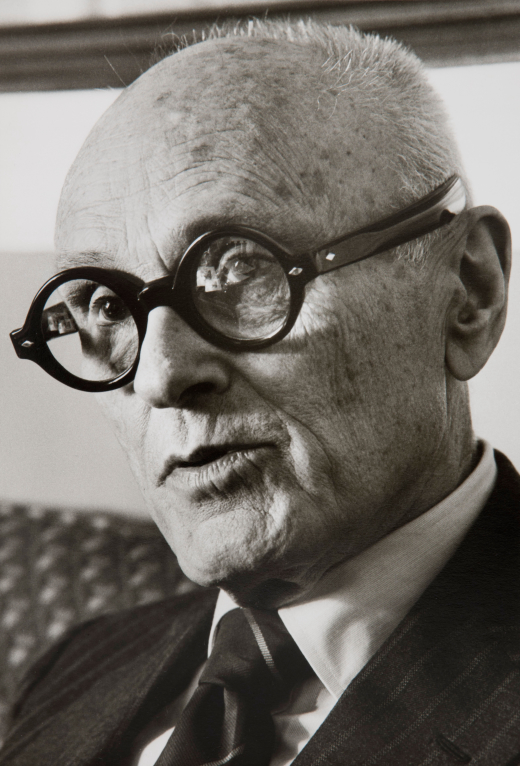
Other relations: Brick House (1949) (1952 floor plan remodeled) one story 1000 square feet building of wood frame construction, measuring 18 feet by 52 feet built of Flemish Bond Brick with façade broken by single black painted door at west and three circular windows at the east, flat roof with sheet metal cornice: architect, Philip Johnson; builder, John C. Smith, New Canaan, Ct. Pool (1955/6) circular concrete pool with rectangular platform and an element in the geometric composition of the site: architect and builder, E.W. Howell Co., Philip Johnson, owner and architect. Lake Pavilion (1962) 32 feet square pre-cast concrete structure with open colonnades situated on man-made pond. Painting Gallery (1965) 60 feet by 72 feet earth berm construction in the shape of an asymmetrical four-leaf-clover, inspired by classical tomb: architect, Philip Johnson, builder, E.W. Howell Co. Sculpture Gallery (1970) glass roofed gallery with complex, five star-like pattern of intersecting rectangles and triangles, pitched roofs made of semi-mirrored glass panes set in metal channels, five levels, inspired by Greek villages: architects, Philip Johnson and John Burgee, builder, Louis E. Lee Co., New Canaan, Ct.Entrance Gates (1977) concrete and aluminum construction: architect, Philip Johnson, builder Louis E. Lee Co., New Canaan, Ct. Library/Study (1980) 15 feet by 20 feet reinforced concrete box in plan and 10 feet high with intersecting cylinder 12 feet in diameter, along roofline cone changes to 8 feet in height truncated cone tapering to 3 feet in diameter oculus: architects, Philip Johnson and John Burgee, builder, Louis E. Lee Co., New Canaan, Ct.Ghost House (1984) open structure of chain-link fencing that refers to separate work of Frank Gehry and Venturi Scott Brown.Lincoln Kirstein Tower (1985) inspired by the choreography of George Balanchine and a tribute to friend and former classmate, Lincoln Kirstein: architect, Philip Johnson. da Monsta (1995) 30 feet by 40 feet highly irregular shaped plan, corners forming acute angles and walls with curving dimensions, inspired by the architecture of Frank Stella: architect, Philip Johnson. Three Vernacular Buildings on site: Grainger (1735 farmhouse renovated ca. 1999) used as a retreat, graffiti window; Calluna Farms (ca. 1890, remodeled 1980, renovated 2000) residence of David Whitney; Popestead (completed as a barn in late 19th century then remodeled as a house in 1920’s and again by Johnson in 1996).Art Collection of Philip Johnson includes works by: John Chamberlain, Lynn Davis, Michael Heizer, Donald Judd, Ibram Lassaw, Andrew Lord, Brice Marden, Robert Morris, Bruce Nauman, Robert Rauschenberg, David Stella, Julian Schnabel, George Segal, Cindy Sherman, Frank Stella and Andy Warhol.